
Pseudomesochra longiseta, Vasconcelos, Danielle Menor, George, Kai Horst & Santos, Paulo Jorge Parreira Dos, 2008
|
publication ID |
https://doi.org/10.5281/zenodo.183913 |
|
DOI |
https://doi.org/10.5281/zenodo.5695056 |
|
persistent identifier |
https://treatment.plazi.org/id/03DC542C-4352-FF93-FF37-7C15FBBA8D1B |
|
treatment provided by |
Plazi |
|
scientific name |
Pseudomesochra longiseta |
| status |
sp. nov. |
Pseudomesochra longiseta sp. nov.
Material. The holotype (18835 MZUSP = 29 slides) is deposited in the Museum of the University of São Paulo ( MZUSP), Brazil. Female holotype was registered at station 6 ( 11°29'42"S 037°09'41"W), depth 492 m.
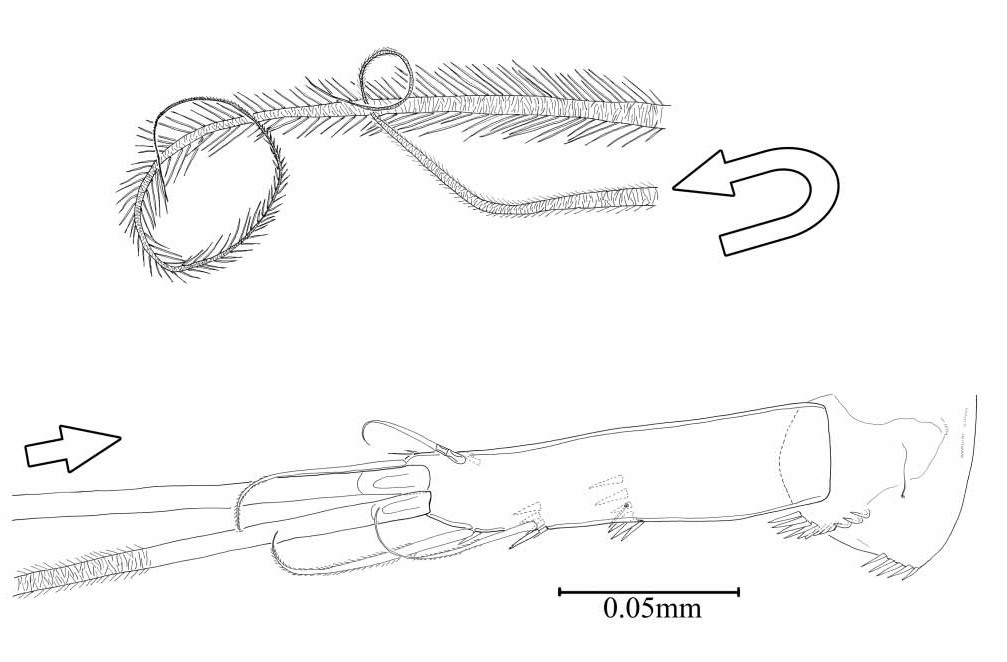
Etymology. The species name longiseta refers to the very long terminal “rattail” seta present on the second segment of the Exp A2.
Description of female Holotype. Habitus ( Fig. 1 View FIGURE 1 ). Total body length measured from anterior tip of rostrum to posterior margin of telson: 0.63 mm. Including the furcal rami: 0.73 mm. There is a distinct separation between broad prosome and smaller urosome; spinules, sensilla and pores are distributed dorsally and laterally on cephalothorax and abdomen. Anal somite broken, with outer spinules and one pair of sensilla.
Rostrum ( Fig. 2 View FIGURE 2 ) very large and broad; two pairs of sensilla located medially and subapically; pore on dorsal surface.
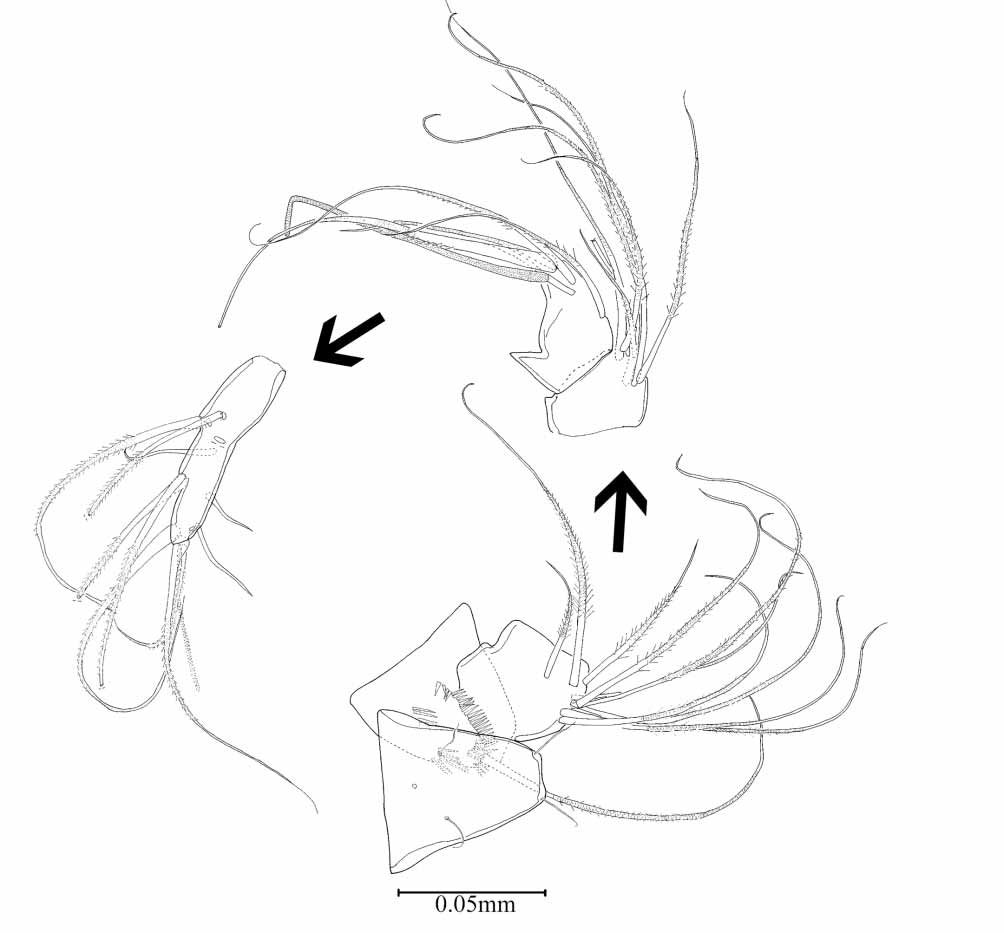
Antennule ( Fig. 2 View FIGURE 2 ) 5segmented. First segment broader than long, trapezoid in shape, with several spinules and 1 “rattail” seta. Second segment nearly square in shape, all setae of “rattail” shape. Third segment smallest, all setae of “rattail” shape. Fourth segment on its outer margin elongate, forming a protrusion which bears an aesthetasc accompanied by 2 “rattail” setae, and with 3 additional “rattail” setae. Fifth segment long, terminally with small aesthetasc, and with 13 setae, 7 of which “rattailed”. Setal formula: 1/1; 2/10; 3/8; 4/5 + aesthetasc; V (13 + aesthetasc).
Antenna ( Fig. 3 View FIGURE 3 ) allobasis with spinules and 1 pinnate seta on outer margin. Exp 2segmented. Exp1 basally with 1 pinnate seta and several spinules, terminally with 1 bare seta. Exp2 proximally with small tube pore and 1 small bare seta, terminally with 1 bare seta and 1 very long “rattail” seta bearing a long tube pore on its distal part. Enp2 with several rows of spinules, 3 “rattail” setae on outer margin, and terminally with 6 “rattail” setae (all broken).
Furcal rami ( Fig. 4 View FIGURE 4 ) four times longer than broad. Setae I–V bipinnate. Seta I very small, located on the proximal half of the outer margin; II on distal half of outer margin; III subterminally on outer margin; IV and V well developed, “rattail” shaped, inserting terminally; seta VI bipinnate; seta VII triarticulate, bare. Spinules present on the outer, inner and terminal margin of the FR.
Mandible ( Fig. 5 View FIGURE 5 ). Corpus large. Gnathobase with bi and tridentate slender teeth; 1 long, pinnate seta on the inner side. Palp biramous; basis with rows of spinules and 4 setae (1 pinnate and 3 bare); exp and enp 1 segmented, enp long and slender, bigger than exp, with 3 lateral setae. Exp with spinules, 6 bare setae and 1 seta.
Maxillula ( Fig. 6 View FIGURE 6 ). Praecoxal arthrite with 9 apical spines and 2 surface setae. Coxal endite with 5 bare setae. Basis armed with 7 slender bare setae. Exp with 2 bare and 1 pinnate setae; Enp with 2 bare setae.
Maxilla ( Fig. 7 View FIGURE 7 ). Syncoxa with 2 rows of spinules and 3 endites. Proximal endite with few spinules, terminally with 3 setae. Middle endite with 1 uniplumose and 2 pinnate spines (one spine with terminal tube pore). Distal endite with 1 bare, 1 plumose, and 1 pinnate spine terminally. Enp not clearly defined at base, with 4 bare setae; syncoxa and basis fused, terminally with 1 strong spine, 1 small and 1 longer terminal seta.
Maxilliped ( Fig. 5 View FIGURE 5 ). Syncoxa and basis each with several spinules and 1 bare seta. Enp fused with seta, forming a bipinnate claw, which bears 1 additional bare seta.
P1 ( Fig. 8 View FIGURE 8 ). Coxa and basis with spinules on distal margins. Basis with 2 pores and 1 inner seta, outer seta broken. Exp 3segmented, enp 2segmented. Exp1 longer than exp2 and exp3 combined. Exp1 and exp2 with outer pinnate spine. Exps1–3 with outer spinules; exp1 additionally with inner spinules; exp2 with inner plumose seta; exp3 with 2 terminal and 2 outer “rattail” setae. Enp1 and enp2 with outer spinules. Inner seta of enp1 with asymmetrical ornamentation. Enp2 with 2 inner setae, terminally with 2 “rattail” setae.
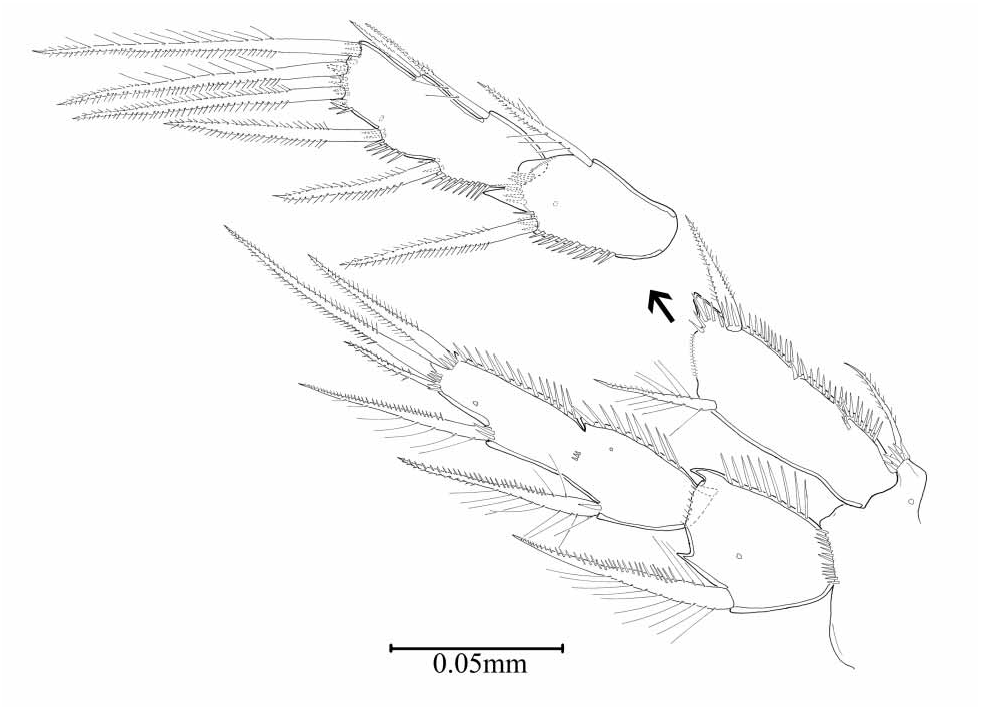
P2–P4 ( Figs. 9 View FIGURE 9 , 10 View FIGURE 10 , 11 View FIGURE 11 ). Swimming legs with pronounced intercoxal sclerite. Coxa of P4 broken at outer margin, with rows of spinules and with pore; intercoxal sclerite with “U” inverted in form and terminal spinules. Coxae and intercoxal sclerites of remaining swimming legs not drawn. Bases with 1 outer pinnate seta, spinules on margins, and 1 or 2 pores. Exps 3segmented, enps 2segmented; exps longer than enps, with pores on the segments. Exps1 and 2 with 1 inner asymmetric seta and 1 outer pinnate spine; P2 exp3 with 1 asymmetric and 1 naked inner seta, 1 asymmetric seta, 1 pinnate terminal seta, and 3 outer pinnate setae; P3 exp3 with 1 asymmetric and 1 pinnate inner setae, 2 asymmetric terminal setae and 3 outer pinnate setae; P4 exp3 with 2 pinnate inner setae, 1 “rattail”, 1 asymmetric terminal setae and 3 outer pinnate setae. Enps1 and 2 with spinules on the outer margin and between the segments. Enps1 with inner asymmetric seta; Enp2 with small spinules on the middle of the segment. Enps2 with 2 inner asymmetric setae, 1 small pinnate and 1 asymmetric terminal setae, and 1 outer pinnate seta. For comparison of ornamentation of swimming legs see Tab. 1 View TABLE 1
P5 ( Fig. 12 View FIGURE 12 ) exp broken. Enp with 2 terminal and 2 inner pinnate setae.






| MZUSP |
Museu de Zoologia da Universidade de Sao Paulo |
No known copyright restrictions apply. See Agosti, D., Egloff, W., 2009. Taxonomic information exchange and copyright: the Plazi approach. BMC Research Notes 2009, 2:53 for further explanation.
|
Kingdom |
|
|
Phylum |
|
|
Class |
|
|
Order |
|
|
Family |
|
|
Genus |