
Primagistemus, Fan & Zhang, 2002
|
publication ID |
https://doi.org/10.5281/zenodo.4619905 |
|
DOI |
https://doi.org/10.5281/zenodo.4619907 |
|
persistent identifier |
https://treatment.plazi.org/id/03C3AA5F-2F5D-4964-8C23-C0ADB356C6E5 |
|
treatment provided by |
Plazi |
|
scientific name |
Primagistemus |
| status |
gen. nov. |
Genus Primagistemus gen. nov.
Type species: Stigmaeus loadmani Wood, 1967: 102 ; based on adult females.
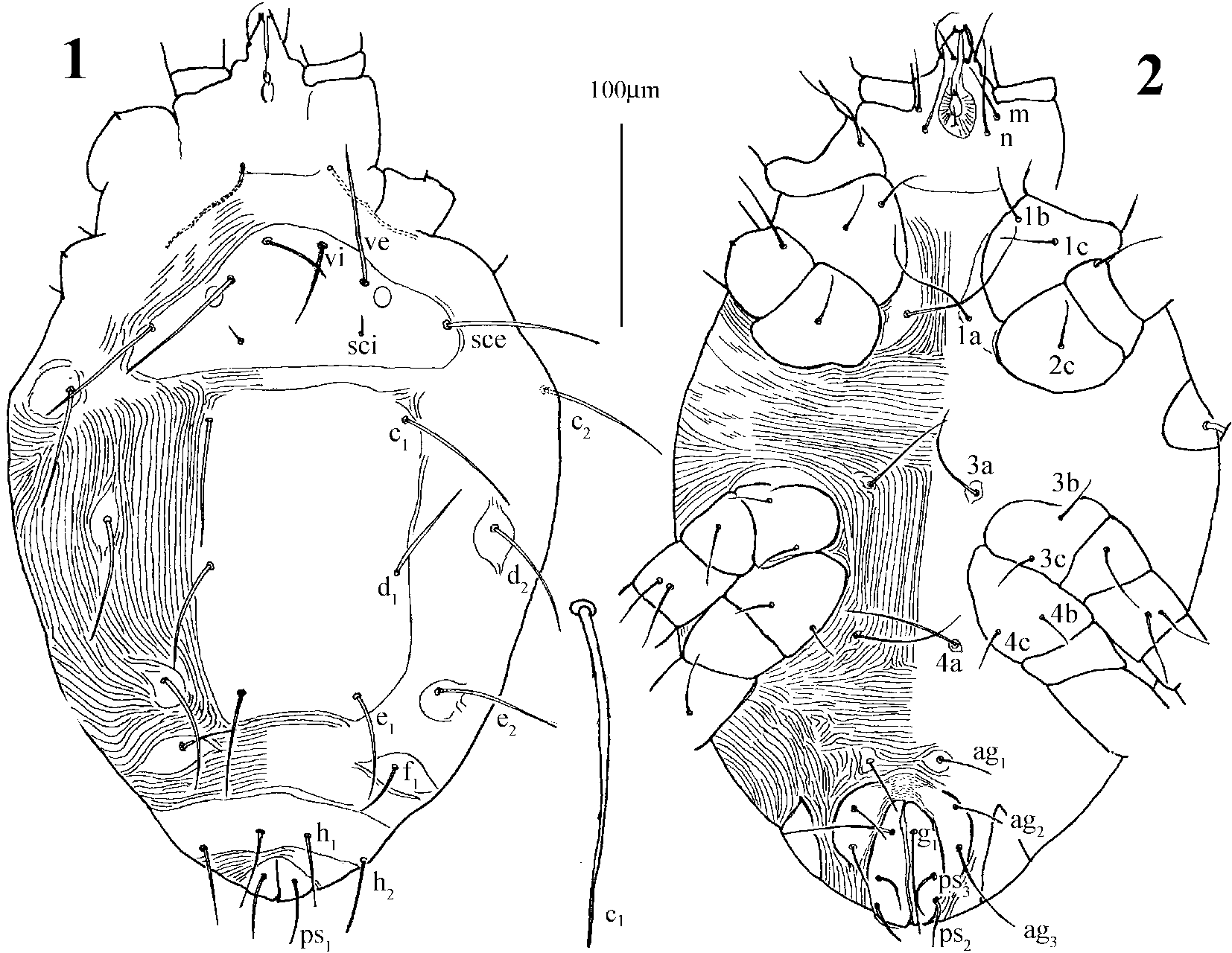
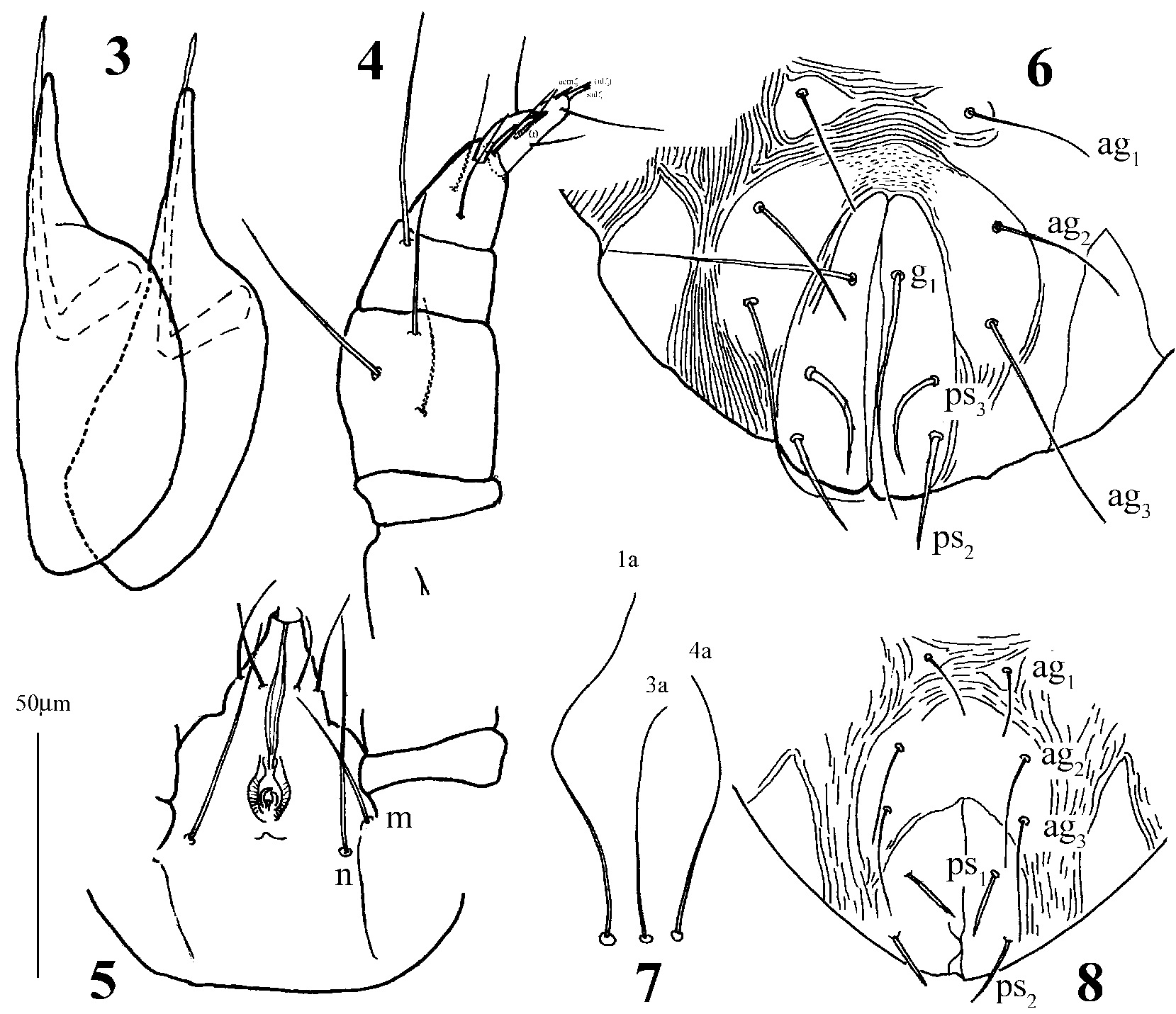
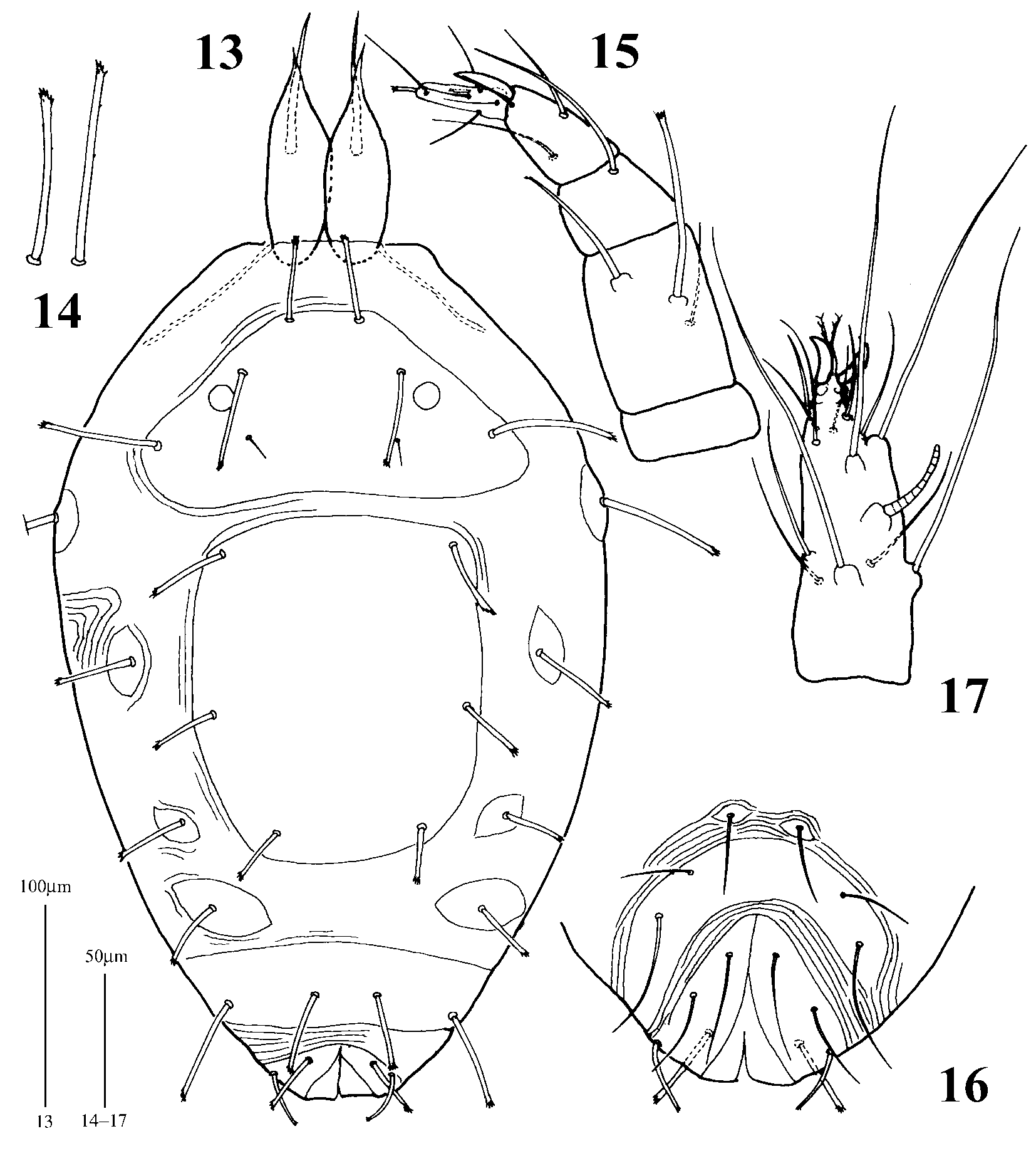
Description of adults ( Figs. 117 View FIGURES 12 View FIGURES View FIGURES 912 View FIGURES 1317 ). Idiosoma oval in dorsoventral view. Chelicerae separate. Palp robust; tibial claw slightly shorter than palptarsus; accessory claw slender. Terminal palptarsal eupathidia fused basally at insertion point and distally divided into 3 minute prongs. Fundamental setation from palptrochanter to palptarsus on adult: 0, 3, 1, 2 + 1 claw + 1 accessary claw, 4 + 1 1 subterminal spinelike eupathidium + 3 basally fused eupathidia. Subcapitulum with 2 pairs of setae ( m and n), both posterolaterad of pharynx, mm wider than nn. Propodosoma covered with a large triangular shield, which bears 1 pair of eyes and 4 pairs of setae ( vi, ve, sci, sce), sci mediad of sce; postocular body absent. Central hysterosomal shield well sclerotized, bearing 3 pairs of setae ( c1, d1, e1). Setae c2, d2, e2 and f1 situated on small platelets. Suranal shield (H) integral, bearing 2 pairs of setae ( h1 and h2). Endopodal shields present around coxae I and II, but absent around III and IV. Ventral setae 3 pairs ( 1a, 3a and 4a). Aggenital setae 3 pairs ( ag1, ag2 and ag3). Genital and anal openings contiguous, with 1 pair of genital setae ( g1) and 3 pairs of pseudanal setae ( ps3, ps2 and ps1) on adult female. Leg tarsal claws well developed, without a prominent membranous arolium. Empodium rodlike, bearing 3 Yshaped tenent hairs. Fundamental setation of legs IIV on adult female: coxae 2, 1, 2, 2; trochanters 1, 1, 1, 0; femora 5, 4, 3, 2; genua 3 + 1, 2, 0, 0; tibiae 5 + 1p, 5 + 1 p, 5 + 1 p, 5 + 1 p; tarsi 13 + 1, 9 + 1, 7 + 1, 7 + 1.
Etymology. The generic name Primagistemus is combined from the Latin prefix “ primi ” (primal) and the generic name, Agistemus . It is masculine in gender.
Taxonomic position. Mites of the genus Primagistemus have 4 pairs of setae on the propodosomal shield, like those in some genera (e.g. Stigmaeus , Pseudostigmaeus , Summersiella , Eustigmaeus and Cheylostigmaeus ). However, many other characteristics (e.g., both subcapitular setae m and n posterolaterad to pharynx; palpgenu with only 1 seta on the adult, terminal eupathidia on palptarsus mostly fused, coxa II with only 1 seta; endopodal shields around coxae IIIIV absent, trochanter III with 1 seta) indicate that Primagistemus is much more closely related to the genera, Agistemus , Zetzellia , Neilstigmaeus , Pilonychiopus and Parastigmaeus .
Remarks. Adult females of Primagistemus gen. nov. are distinguished from those of Agistemus by having 4 pairs of setae on the propodosomal shield, by lacking postocular bodies, by having 3 pairs of aggenital setae, and by having 2 setae on genu II. They are also distinguished from those of Stigmaeus by the terminal eupathidia on palptarsus being mostly fused and subterminally separated into 3 minute prongs, by both subcapitular setae posterolaterad of pharynx, by having only 1 seta on coxa II, and by lacking endopodal shields around coxae IIIIV.

No known copyright restrictions apply. See Agosti, D., Egloff, W., 2009. Taxonomic information exchange and copyright: the Plazi approach. BMC Research Notes 2009, 2:53 for further explanation.
|
Kingdom |
|
|
Phylum |
|
|
Class |
|
|
Order |
|
|
SubOrder |
Prostigmata |
|
Family |